 Portraitwise
Professional portraits2 min readSee the latest articles
The eleven criteria of a good professional photo
Face, framing, rendering: the eleven-criteria grid our free analyzer uses, with its weightings and a ten-minute self-diagnosis method.
 Written byLa rédaction
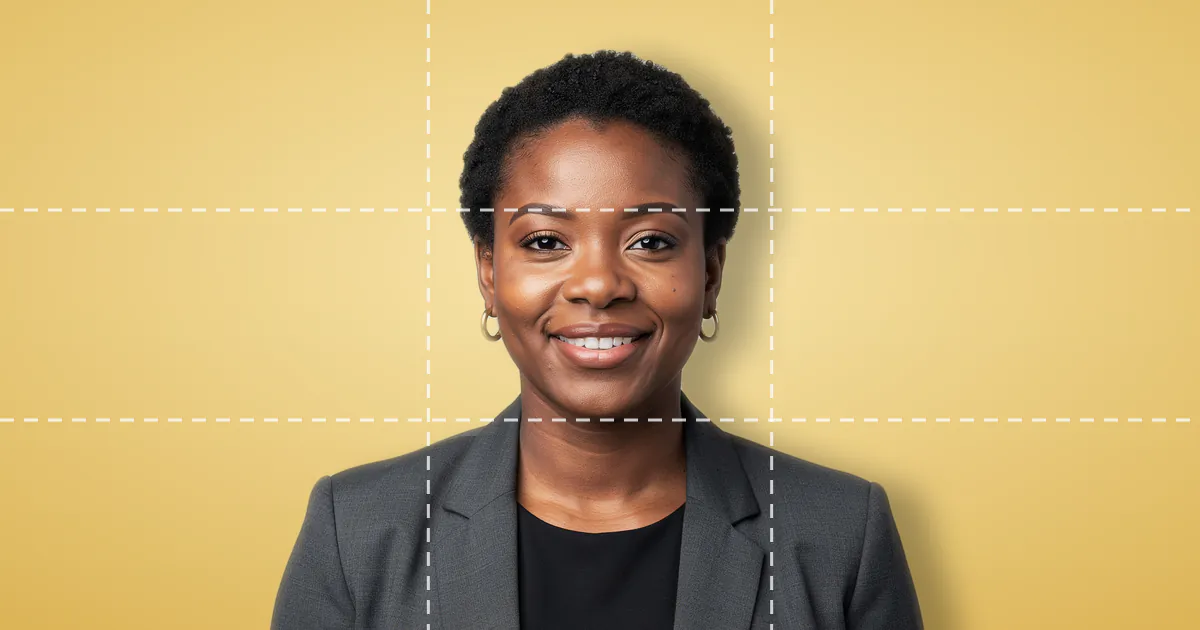
This article belongs to the section Professional portraits
Why score a photo rather than judge it
Ask five people whether a photo is good and you get five opinions and no action. Ask them to score sharpness, framing and background separately, and disagreement shrinks to one or two lines. A grid does not replace taste: it separates what can be fixed from what is preference.
The three face criteria
The smile must be consistent — if the lower eyelids do not rise slightly, it is purely a mouth movement. The overall expression covers jaw tension, eyebrow height and head tilt. The gaze covers direction, openness and eye sharpness: focus must land on the eye closest to the lens.
The five framing criteria
| Criterion | What is measured | Typical flaw |
|---|---|---|
| Tightness | Share of the frame taken by head and shoulders | Subject too far, tiny face as a thumbnail |
| Placement | Eye line position and horizontal centring | Eyes in the middle, head squashed low |
| Posture | Shoulder alignment, tilt, neck tension | Perfectly square shoulders, ID-photo effect |
| Clothing | Sector fit, collar cleanliness, absence of fine patterns | Thin stripes that moiré under compression |
| Background | Neutrality, no attention-grabbing element | An identifiable object behind the shoulder |
The three rendering criteria
Light is judged on direction and softness: a single source in front and slightly above gives a short shadow under the nose. Sharpness is checked on the eyelashes and the hairline, not the center of the face. Exposure is checked on the highlights of forehead and cheeks: a blown area holds no information and cannot be recovered.
How the criteria are weighted
The background weighs twice as much as the clothing, and more than the smile. At real avatar size, a busy background destroys the readability of the silhouette, whereas a debatable outfit remains an outfit. Face carries twenty-three per cent, framing forty-three, rendering thirty-four.
Ten-minute self-diagnosis
Shrink the photo to 130 pixels
That is the real display size of an avatar. If the face is no longer readable, stop: the problem is tightness.
Convert to black and white
Color hides lighting problems. In grayscale, a misplaced shadow becomes obvious.
Zoom to 200 % on one eye
If the eyelashes are not sharp, focus landed elsewhere, and no retouching recovers that.
Describe the background in one sentence
If your sentence contains an object name, the background talks too much.
Note the single weakest criterion
Fix that one before shooting again. Fixing two at once makes the result impossible to interpret.
The mistakes that cost the most points
Five mistakes stand out: backlight, which costs points on both light and exposure, a cluttered background, framing that is too wide (up to ten points on its own), a mouth-only smile, and the wide-angle phone held at arm’s length, which genuinely changes facial geometry at thirty centimetres. Step back a metre and crop afterwards. You can run this grid on an existing photo with our free analyzer.
Have your portrait checked against the same grid
Analyze my photoWritten by
La rédaction
Editorial team
Articles are written by the team that builds Portraitwise. They cover framing, light, tools and image rights.
Read next
Reference page: LinkedIn headshots
Frequently asked questions
Why does the background weigh so much?
- Because it is judged at thumbnail size, where a busy background destroys silhouette readability, and because it cannot be fixed cleanly afterwards: cutting out almost always leaves a fringe in the hair.
Is a score of 100 achievable?
- In practice no, and that is not the point. Above 85, differences are a matter of taste. The grid exists to spot a fixable flaw, not to rank good photos.
Does the grid apply to generated portraits?
- Yes, identically: the criteria do not depend on how the image was made. Run a generated portrait through the free analyzer the same way you would a photograph.
Your professional portrait, made from your own photos
Send at least 8 pictures of yourself, pick your styles, get a batch of 4K portraits ready to publish.
In the same section
All articles in this section
LinkedIn profile picture: framing, light and outfit
Technical limits, framing, light, clothing and expression: the full method for a LinkedIn profile picture that stays sharp, credible and up to date.

Seven settings that bring a LinkedIn profile to life
Banner, headline, About section, experience, recommendations: the settings that extend the effect of your photo, and how to measure their impact in thirty days.
Should you put a photo on your resume? Seven mistakes to avoid
Should a resume carry a photo at all? And if so, how to avoid the seven framing, background and clothing mistakes that get applications set aside before reading.